

Decoding Sweet Taste
- Jeffrey Pramoda Petsch
- Apr 26, 2020
- 13 min read

Thousands of years ago, the science of taste, or rasa, was decoded by Ayurveda. They learned that when one experiences taste, they are really tasting specific combinations of elements. When those elements touch a wet tongue we experience those elements though taste sensation. Since taste correlates to the elements, and each element implies unique qualities and effects, tasting a substance usually allows one to make accurate predictions about the effects of the item on the body and mind.
When any food or material makes contact with saliva on the tongue, taste sensation will occur. The mixing of food with one’s saliva causes the first chemical changes. From this first chemical change, certain electromagnetic stimuli are generated which communicate with the gustatory center in the brain. Depending on the signal’s qualities, different tastes will be perceived. The body then selects appropriate proportions of digestive juices, ie. Saliva, Pepsin, Renin, HCL, Bile, Insulin, etc. which activates our digestion.

Natural Examples of Sweet Taste
Ripe Fruits: Apples, Bananas, Dates, Mango, Coconut, Berries, Peach
Grains: Rice, Wheat, Quinoa, Oats, Tapioca, Barley
Dairy Products: Milk, Cheese, Butter, Ghee, Cream, Fresh Yogurt
Vegetables: Beets, Sweet Potato, Squash, Carrots, Onion, Asparagus
Meat: Poultry, Beef, Pork, Lamb, Fish, Shrimp
Sweeteners: (All), Sugar, Honey, Maple Syrup, Jaggery, Molasses, Stevia
Fats: Coconut Oil, Butter, Ghee, Avocado, Sesame, Animal
Legumes: Pinto, Peanut, Dal (Lentils), White, Peas
Nuts and Seeds: Sesame, Sunflower, Almond, Cashew, Pistachio
When one envisions sweet flavor through our modern lens, most probably see some version of candy, cookies, or chocolate. However, it’s not just ‘sweets’ that are sweet. Most fats, proteins and carbohydrates also have sweet flavor. Meat, butter, rice, and wheat are all sweet. However, one may subjectively not experience sweetness when eating plain bread and butter if their taste buds are accustomed to candies or processed food. Desensitization to sweet signals that there is a distortion of an individual’s taste buds and pleasure sensors, or a ‘tolerance.’
The above list is not exhaustive. Most everything humans eat contains at least some sweet taste. Even when one eats something that doesn’t naturally have sweetness like Arugula, they usually add some sweetness through dressings. Also, most food naturally contains multiple tastes. Fruits are often sweet and sour. Nuts and seeds may also be bitter and astringent. Vegetables often possess combinations of sweet, bitter, and astringent tastes. Some foods are only sweet. These are often the most nutritive and building substances. Sugar, honey, syrup, milk, wheat, rice, dates, fruit juice, ghee, oil, beef, and almond are among the 'super sweets'. Therefore, it’s no coincidence that modern civilization utilizes these substances for the majority of their calories.
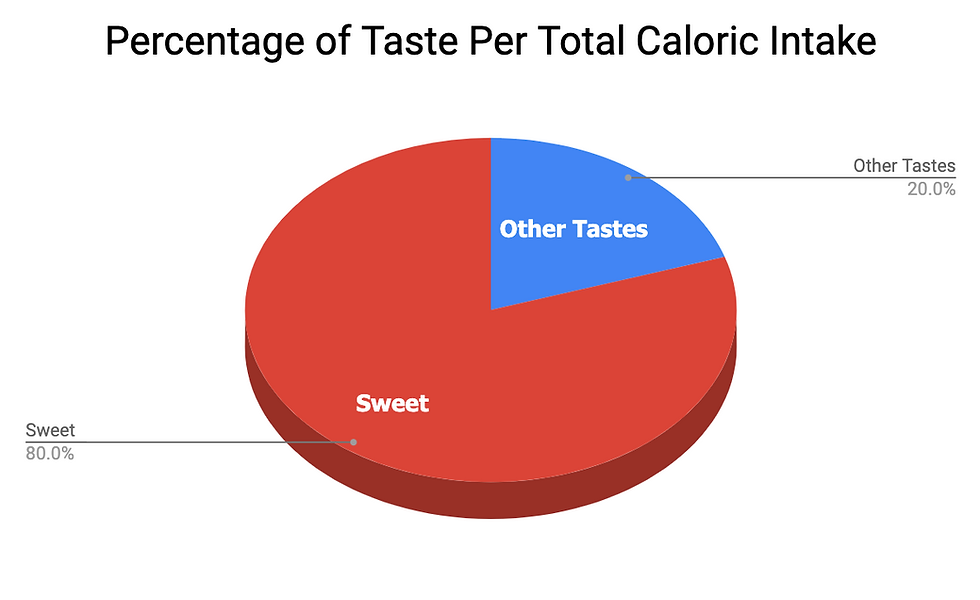
One central, unifying theme in Ayurveda is “It Depends.” Since everyone’s problems are unique, there is never a perfect one size fits all solution. This chart still leaves plenty of room for adaptation. It’s important to note that the sweetness of ripe date is much more intense than the sweetness in a sunflower seed or pinto bean. Meaning that a Kapha-Type (heavy) person can still consume a primarily sweet diet, as long as they choose options which contain more complex carbohydrates and protein like quinoa, vegetables, fish, poultry and nuts. Also, depending on one’s present health concerns, the size of the pie or, total caloric intake, varies. Someone with issues of excess (Kapha-Type) should eat less total calories than someone with degenerative issues (Vata-Type) or inflammatory issues (Pitta-Type).
To determine what is best to eat in the 'other 20%' refer to the tastes that reduce (↓) each dosha from the first chart. For Vata management sour and salty are therapeutic or reducing. Pitta is relieved through Bitter and Astringent. Whereas Kapha should consume more Bitter, Pungent, and Astringent. If Kapha is already in excess, then one can reduce their percentage of sweet to less than 80% as well as reduce their total caloric intake.
“Sweet is the character which tempts the individual to consume all the material.”
Sweet is the most building, and satisfying taste. It is classically regarded as “The character which tempts an individual to consume all the material.” Since sweet is composed of the two heaviest elements, earth and water, tasting sweet is normally associated with eating the most energy and nutrient dense foods, making it instinctually craved and prized. Sweet berries, sweet meat, sweet milk, and sweet honey may give a hunter/gatherer type human enough energy reserves to survive times of scarcity. Because of this, turning down dessert or not finishing that plate of comfort food can be tough, even if one is already full. The animal brain wants to keep eating while the eating’s good!
When sweet is not exploited, we find that mildly sweet tastes bring us the greatest satisfaction. It provides us with most of our overall caloric intake and nourishment. Sweet sustains our bodily tissues and allows people to gain strength and mass. Still, sweetness is best experienced when it’s earned. Eating a nutrient dense diet is only essential if one is actively utilizing their body through physical work, exercise, or an active lifestyle. The naturally sedating nature of sweet taste isn’t appropriate for the lazy or lethargic. Celebrating a sedentary lifestyle through sweets creates a self-reinforcing cycle.
Diversifying one’s diet with the additional five flavors actually improves one’s ability to digest sweetness. Bitter will reset one’s taste buds. Any sweet flavor is amplified when consumed next to something bitter. Meaning bitter not only helps one digest sweet, but it also decreases sweet craving. Pungent, Sour, and Salty flavors stoke the digestive fire and can also improve the digestion of the heavy sweet flavor. Astringency can dry and reduce the excess water retention, mucous, and sexual secretions that commonly accompanies sweet taste. Milk, for example, could provide most of our necessary nutrition, but plain cold milk is mucilaginous, heavy on digestion, and can drown out one’s digestive fire when consumed in excess. If one heats up their milk and adds turmeric, black pepper, saffron, cardamon, etc. then one’s body is better able to digest it. Infusing pungent, bitter, and astringent qualities into the milk balances the otherwise overwhelmingly sweet, heavy, and unctuous substance. Contrarily, to make ice cream one cools milk down and adds refined sugar, making it exceptionally hard to digest.
While both sour and salty are heating and beneficial for digestion, sometimes strong sour flavor doesn’t meld well with intense sweet (Don’t add acid to milk unless you want it to curdle!). This will be discussed more in “Incompatible Food Combinations.” Similarly, while salt stokes digestion, it is also an anabolic taste that can contribute to diseases of excess like water retention, diabetes, and heart disease. So, if someone is experiencing these types of issues then salt should not be taken with sweet. One size certainly does not fit all. Still, overall, while sour and salty do improve overall digestion they are often less biologically complementary to sweet taste than pungent, bitter and astringent.
Sweet’s Effect on Tridosha
V↓ P↓ K↑
Since Sweet Taste is composed of the same elements as Kapha Dosha (water and earth), sweet taste generally aggravates or increases Kapha Dosha. Kapha is already heavy, dense, and unctuous and is balanced by the reducing tastes: Pungent, Bitter, Astringent. Contrarily, the heavy, dense, and building earth and water elements that make up sweet taste are highly therapeutic for Vata Dosha. For Pitta dosha, the cooling energetic, anabolic or building property, and calming effect of sweet taste makes it beneficial or reducing. Therefore, if one’s constitution or current imbalance is of kapha nature (disease of excess), they would likely be better off eating less than 80% of their nutrition through predominately sweet substances, instead favoring ones that predominate in pungent, bitter, and astringent taste. For Vata and Pitta types, they can consume the 80% sweet recommendation, but Vata should supplement with more sour and salty taste while Pitta adds more bitter and astringent taste for optimal results. Sweet and sour citrus, for example, can be aggravating to pitta, leading to hyperacidity and inflammation when consumed in excess. This is because adding sour flavor makes a substance more heating, which can reduce sweet’s efficacy as an anti-inflammatory.
Physiological Effects of Sweet Taste
Building, Grounding, Calming, Strengthens Tissues, Supports Immunity, Benefits the Senses, Benefits Hair, Supports Complexion, Supports Children and the Elderly, Reduces Degeneration, Anti-Inflammatory
Through understanding the qualities of a substance, one can eventually infer most of their biological and physiological effects. We explore this topic in more detail in a previous article explaining the 20 qualities of Ayurveda: The 20 qualities.
Sweet is primarily characterized by heavy, dense, cooling and unctuous qualities. In general, heavy, dense, cooling and oily (unctuous) qualities will give a substance a building or nutritive effect. Any degenerative issues such as Mal-Nourishment, Atrophy, Osteoarthritis, Osteoporosis, and Alzheimers can be supported through sweetness. Children and the elderly often need sweet taste the most: Children need it to promote growth while the Elderly need it to prevent their decay.
The cold quality and nutrient density that characterize sweet is useful in improving complexion. Most skin issues come from some level of toxicity or inflammation in the blood, which delivers those inflammatory properties to the skin. Excess heat is also one of the main reasons for hair loss. Those little hair follicles get roasted and toasted! Sweet also gives one a level of hydration or ‘juiciness’ which prevents dry skin and hair. Cold quality is also beneficial for inflammatory disorders since excess heat creates is cooled through sweet taste. Cold quality is also naturally anabolic or building. Over generations, exposure to cold climates generally give rise to bigger and stouter bodies.
The unctuous quality of sweet lubricates dryness and reduces friction, deterioration, and mental irritation. Dense quality also helps by providing a density of vitamins, minerals and fortification to our bodily tissues. When density increases, gravity’s effect increases. So a dense and sweet substance gives one a grounding and stabilizing effect.
Psychological Effects of Sweet Taste
Contentment, Satisfaction, Love, Happiness, Compassion, Wholesomeness, Attachment, Greed, Possessiveness, Complacency
In Ayurveda, the mind primarily lives in the heart and the head. However, those are simply the places where we have the highest concentration of activity. In actuality, the mind is said to exist in every cell in our body. No where can one be touched without some effect happening to the mind. Whether the touch is of pain or pleasure, requested or uninvited, here or there, the mind has some response. Any time the senses or nervous system is engaged, some effect is felt in the mind. Recent studies have shown that GI health can be as impactful as anything on one’s mental and emotional wellbeing as their brain itself. Imagine how much the contents of your stomach can impact the thoughts in your head. The mind certainly manifests through the stomach as well!
Sweet instills relief to the hungry, fearful, and insecure. Contentment, happiness, joy and satiation also accompany sweet taste, not unlike the feeling from a ‘sweet experience'. The satisfaction and complacency of sweet is a cold and constricting emotion because it lessens the mind’s appetite for enjoyment. After a rich dessert, one should sufficiently lose their appetite and feel ready for the couch or bed. After a rich experience, one also experiences contentment. The thoughts slow down and one feels the capacity to simply exist. It’s the pleasant feeling of a cool breeze, which soothes the mind and cools one’s sense of irritation.
When one feels the absence of love in their life, they may be drawn emotionally towards the consumption of sweet flavor, and it doesn’t have to be only candy, cookies and chocolate. Even excessive carbs, meat, and cheese consumption could be excessive 'emotional eating.' Since sweet is heavy, dense, and oily in nature, its use in excess causes lethargy and laziness. After a lion eats a fresh kill of sweet flesh, it becomes sleepy and dull. Sleeping after a meal amplifies the effects of sweet by making it more anabolic or building. When too much sweet is consumed, love can turn into attachment, contentment into greed, and satisfaction into possessiveness. If you consume too much of one thing, you eventually lose the capacity to process it. When one feels ‘smothered’ with love, their over-satiation causes aversion towards their partner.
In a relationship, it’s not uncommon for one party to become possessive and attached. Since the experience of love and sweetness is so satisfying, it’s natural to become attached to it. We don’t want to let go of the things that bring us joy. From fear of losing one’s source of love and sweetness, it is also common to observe one or both partners become possessive of the other. Imagine how a lion reacts to a hyena trying to steal its kill, or how a bee would respond if you try to take its honeycomb! Is this any different than a man’s reaction when another tries to ‘steal’ his wife? Ownership is a ‘sweet’ idea, and when someone is possessive they are inherently claiming ownership of the individual or substance they become possessive over. The bitter truth is that nothing can be truly owned, because nothing is truly permanent. The only thing that can be temporarily owned is one’s own person, but hardly any can ever even become master of their own self.
Keys to Choosing the 'Right' Sweet Substances
When it comes to sugar and sweets, our taste buds are often tricked by our food industry. Processed sugars and flours are better regarded as a drug or poison than food. Processed food loaded with white flour, refined sugars and hydrogenated oils act much differently in the body than oatmeal, apple, and coconut oil. Processed foods cause inflammation, sharp peaks in blood sugar, and destabilize one’s mind and emotions. In its perverted forms, sugar and sweet can subject us to all of sweet’s ill effects and none of its blessings.
To decode this phenomenon, it can be helpful to consider a fruit such as the blueberry. Before a blueberry is ripe, it will contain a great deal of sour or tartness. This acts as a natural pesticide. As the berry ripens, it internally undergoes a process of ‘pre digestion’. In this process, the berry chemically changes as it ripens, resulting in more sugars and bio-available energy. From the blueberries perspective, it knows that encasing its seeds in a sweet substrate will allow them to sprout again in the manure of an animal’s feces, so it entices one to consume it. Once the blueberry ripens it becomes a purely sweet substance and a prized meal for humans, animals, and insects alike.
After one picks the ripe blueberries, they may go through additional processing such as juicing and cooking. These processes further increase the availability of the food’s sugars and concentrate its sweetness. By juicing a fruit, one isolates its sugars by removing all the fiber. As a result, when one drinks a cup of blueberry juice, they receive as much sugar as they would if they had consumed an entire quart of blueberries. Not only does this processing allow one to consume more sugar without actually ‘filling up’, but the process of removing the fruit’s fiber also causes all its sugars to be released at once, creating a more severe blood sugar spike. On the other hand, if one cooks and eats the entire blueberry, they can benefit from predigestion and still maintain the fruit’s matrix of fibers that allow for healthy assimilation into our bodies.
Processed foods and candies are the worst example of this phenomenon. They process sugars, carbs, and fats into their most egregious and volatile state, and then combine them all together and sell their final product next to the cigarettes, alcohol, and soda. When one walks into a 7-eleven it’s not a matter of choosing the healthy option, it’s a question of whether one wants to get their fix through a solid, liquid, or smoke.
Contrarily, more dense and complex nutrients such as meat, milk, or almonds use the heat of cooking to predigest, which gives our bodies the opportunity to a higher percentage of its overall nutrition. Eating raw meat is not only dangerous because of infection, but also dangerous because most digestive tracts are not hot enough to transform meat into bioavailable amino acids unless it has undergone the process of predigestion that cooking over a fire provides. Even after proper marinating and cooking, meat is arguably the most difficult natural food to digest. This means that its consumption should not be practiced regularly. If one requires the nutrient density of animal flesh, cooking bone broth or stock is the best way to receive its benefits without overwhelming digestion and subjecting oneself to the ill effects of excess sweet substance.
Signs and Symptoms of Excess Sweet Consumption
Cold, Congestion, Cough, Laziness, Lethargy, Apathy, Obesity, Growths, Tumors, Hypothyroidism, Edema, Diabetes, Heart Disease, Parasites, Gas
Since we know cause is effect concealed, and effect is cause revealed, when one suffers from the 'signs and symptoms of excess sweet taste,' one can infer that reducing sweet taste should be beneficial to their health. Most Kapha type issues (diseases of excess) fit into this category. Common problems like respiratory and sinus congestion, weight or water retention, low BMR, hypothyroidism, growth, cysts, tumors, frequent urination and diabetes all reveal that sweetness is likely being consumed in excess.
Keys to Healing One’s Relationship with Sweets
Dietary Changes, Active Lifestyle, Increased Exercise, Bitter Pungent and Astringent Herbs, Engaging in Meaningful Relationships
Reducing one’s intake of sweet, savory, fatty, starchy, and dense foods is no small task. There are many reasons that one can find themselves overindulging. Some people receive too much exposure to radioactively sweet food and drink as a child which distorts their taste perception and can instill longterm unhealthy eating habits. Other people experience abuse or trauma which triggers emotional eating as a coping mechanism. Some people don’t consume excess sweetness, but since they live a totally sedentary lifestyle sweet flavor still causes adverse effects. Still others possess a genetic intolerance towards sweets, such as a severe predisposition towards obesity and diabetes. I’ve heard some say that they can “gain five pounds simply by looking at rice.”
When one starts the process of healing their relationship with sweet, it is important to understand the broader implications of the taste's qualities to maximize chances of success. Since sweet possesses Cold, Oily, Heavy, Dense, and Gross qualities, sweet can be reduced or balanced through its opposites: Hot, Dry, Light, Liquid and Subtle. While diet is a crucial part of healing the effects of excess sweet, also including exercise, herbs, lifestyle and spiritual practices provide one with additional opportunities to heal.
Hot quality stokes digestive fire, better enabling the body to process cold and heavy sweetness. Heat also combats the lethargy and complacency that sweet afflicts on the mind by igniting emotion, passion and drive. Dietarily, heat is obtained through sour, pungent and salty tastes. The best single remedy is to add lemon juice, salt and pepper to a slice of ginger (Ginger Pickle) as an appetizer. Viola.
All types of exercise generate internal heat, improve circulation, and increase metabolism. In regards to exercise, regularity is more important than intensity because exercise done daily will have compound effects over time. Intense, irregular exercise can be more biologically confusing than it is affirming. And for mitigating the ill effects of excess sweet taste, cardiovascular exercise is better than aerobic exercise.
Herbally, these people often need to take bitter herbs. Turmeric, Guducci, Neem, Kutki, Kalmegh, Fenugreek, Bitter Melon, and Cumin all contain bitterness and therefore are helpful. Also, taking the pungent herb Trikatu (ginger, black pepper, long pepper) stimulates digestion and metabolism and can cause weight loss, etc. Punarnava utilizes Astringency to dry-up excess Kapha, especially in the lungs. Triphala or Bhumyamalaki taken before bed gently purges the liver, improves metabolism, and removes digestive toxins and parasites out of the body through the next morning's BM. There even exists an herb called Gurmar which temporarily inhibits one's ability to taste sweet, earning it the title of “sweet killer.”
Since sweets are often eaten emotionally, and used to supplement the absence of love and contentment in one’s life, restoring healthy relationships can have a huge impact in one’s ability to eat fewer sweets. This subtle work of emotions, communication, and gratitude practiced in relationships are helpful to combat the dense and gross nature of sweet taste. For some people this may require ending a loveless marriage or partnership. Others may need to harness the confidence to ‘get back out there’ since it’s nearly impossible to fall in love if one is too afraid or insecure to go on a date. Not only does love imbibe true sweetness, but the heat of passion and love making also burns calories and gives one something to lust over besides their favorite cheeseburger and fries!
Ultimately, there is nothing more sweet than feeling and communing with the presence of something beyond oneself, be it God, Nature, Universe, Shiva or Ma. In fact, it is the only love that one can guarantee will always be there. All worldly relationships and possessions pale in comparison to the sweetness of faith and devotion. If someone obtains true faith, they will no longer require the crutch of candies to put a smile on their face.
Thank you for your attention, stay tuned for our next taste: Sour or Amla.
Comments